One project – one contact
Our service package includes a fixed contact person throughout the whole project. So our customers aren’t sent from A to B and don’t have to explain everything all over again. That saves time and nerves.
High-tech made in Krefeld
Across 2,500 m² we have brought together high-performance technology that is just waiting to realise your projects: these include UV flatbed printers, inkjet roll printers for printed products up to 3.20 m wide from Mimaki and OKI, the Esko-Kongsberg C64 cutting plotter, solvent printers, a letter bending machine and a CNC milling machine from Harmuth.
And then out and about all over Germany
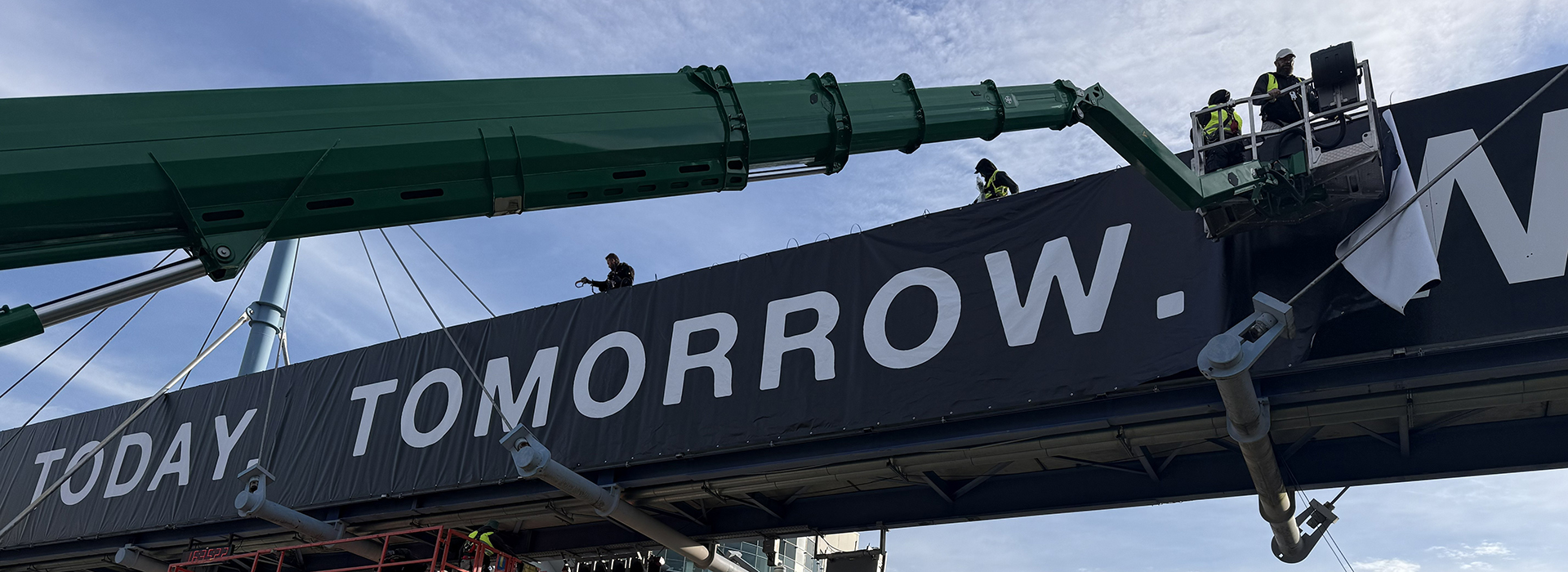
Our signage technicians are out all over Germany so that everything ends up in the right place. Although our head office is in Krefeld on the Lower Rhine, we supply not only the surrounding cities such as Düsseldorf, Mönchengladbach or Duisburg, but all the other cities in NRW too.
Your company headquarters isn't in Düsseldorf, Mönchengladbach or NRW? No problem. With our in-a-flash service we're on site anywhere in Germany within a few days. No matter whether our customers are based in Hamburg, Munich, Berlin or Frankfurt.
Signage in Switzerland or Austria? Yes, happy to
We are also getting more and more enquiries from neighbouring countries such as Switzerland or Austria. And yes, we are of course happy to go there too.
We can also do signage expertise
The daily bread of Blaue Erdbeere – signage and everything that goes with it. So you can talk shop with us, you’ll find some technical terms from the signage technician’s trade explained in more detail here. We can do not only creative practice, but in-depth theory too.
Acrylic
Acrylic is the be-all and end-all of illuminated advertising – without acrylic, almost nothing works for us. It can be formed into shape well and can be used both indoors and outdoors. It allows good machining, can be cut or engraved very well, and is more scratch-resistant than other thermoplastics. The material can be sourced crystal-clear, or opaque or translucent in many colour variations. Joints by bonding or welding are possible. It transmits light, takes colour well, and resists weather and ageing. It also absorbs UV light. In short: impossible to imagine our signage without it.
Aluminium, Alu for short
Aluminium is a relatively soft but at the same time tough metal. With a density of 2.7 g/cm³, the light metal is extremely ductile and can be processed into thin foils by rolling. That is why aluminium, in the form of sheets and profiles, is a premium material in illuminated advertising and is worked by us every day.
Corona effect
With the corona effect, light is cast back onto the façade.
Dibond®
Dibond® is a product name of the company 3A Composites for an aluminium composite material. It consists of lacquered aluminium cover layers and a polyethylene core. Colloquially, all aluminium composite panels are referred to as Dibond® material. Strictly speaking, only the material from 3A Composite can be called Dibond®, because in part there are considerable differences in quality and materials. We use Dibond®, for example, for signs in wayfinding systems that are printed with one of our flatbed printers. This flatbed printer was not bought specifically for Dibond®, by the way, but is also used for it, among other things. We also produce perimeter advertising with it, for example at football pitches, and also car-park signs or pictures. We can also rout letters from Dibond®.
digital print
Digital printing (Digidruck for short) is a group of printing processes in which the print image is transferred directly from a computer to a printing machine, without a static printing form being used. The printing system is usually an electrophotographic printing system such as a laser printer built for high print runs. In digital printing, the artwork is printed with a large-format printer (2400dpi) directly onto the translucent film. Many colours and unusual colour gradients can be shown particularly impressively with the help of digital printing. Picture it like printing photos in colour. It is therefore important to use artwork with a resolution of at least 300 dpi. Phone photos are usually not available in the required quality and cannot be used. A photo from a digital camera, by contrast, can be used directly. We have several printers that we use for poster printing. For example, UV printers and solvent printers in various sizes. With these we can print the following widths: 3.20 m, 2.50 m, 1.60 m, and the flatbed printer can do 3 x 2 m. The length on the roll is always 50 m.